
Collect your fees08 / 11
The fees are late, and the fine has to be calculated child by child.
Fee collection is not hard because parents will not pay. It is hard because calculating what each child owes takes a spreadsheet, and following up what has not arrived takes a list nobody maintains.
Collect your fees/The problem today
You are not short of a system. You are short of one that agrees with itself.
- The fee structure lives in a spreadsheet that one person understands.
- Concessions and sibling discounts are applied by hand, differently by different people.
- A parent disputes an amount and it takes three people to reconstruct how it was calculated.
- The defaulters list is built fresh each time somebody asks for it.
- A late fine is due and the rule for it is your own, so somebody applies it one child at a time.
- Two people ring the same parent in the same week.
- At year end the whole structure is rebuilt from last year’s file, with last year’s mistakes.

Collect your fees/What EduBold changes
Rules decide what each child owes.
Fee rules 2 rules · both active
+ Add rule| Priority | Rule name | Condition | Actions | Status |
|---|---|---|---|---|
| 1 | Staff Ward · 50% discount on all fees | STAFF_WARD = Yes | 6 actions · 50% discount | ✓ Active |
| 2 | EWS · tuition fee waiver | RTE = Yes | 1 action · waive 100% tuition | ✓ Active |
A rule is a school policy, written once. The engine applies it every month.
You describe the conditions once.
Conditions chain with AND and OR, and read the student’s own attributes. When a rule matches it does one of four things. It applies a percentage discount, or a fixed discount. It waives the fee. Or it adds a fee component that is not in the base plan at all.
So the staff child, the sibling, the scholarship holder and the transport user are handled by rules rather than by somebody remembering.
You see the effect before you commit to it.
Auto-assignment runs as a dry run first. You see exactly which students would get which charges, and nothing is written until you commit.
The same applies to fee plans. Save this year’s structure as a template, preview what applying it would create, then apply it.
Billing is a run, and the run is auditable.
Month-end processing bills the school. Large runs go asynchronously so the office is not frozen while it happens.
Every run is logged. When somebody asks in February what happened in the October billing, there is an answer.
Collection at the counter, posting itself to the books.
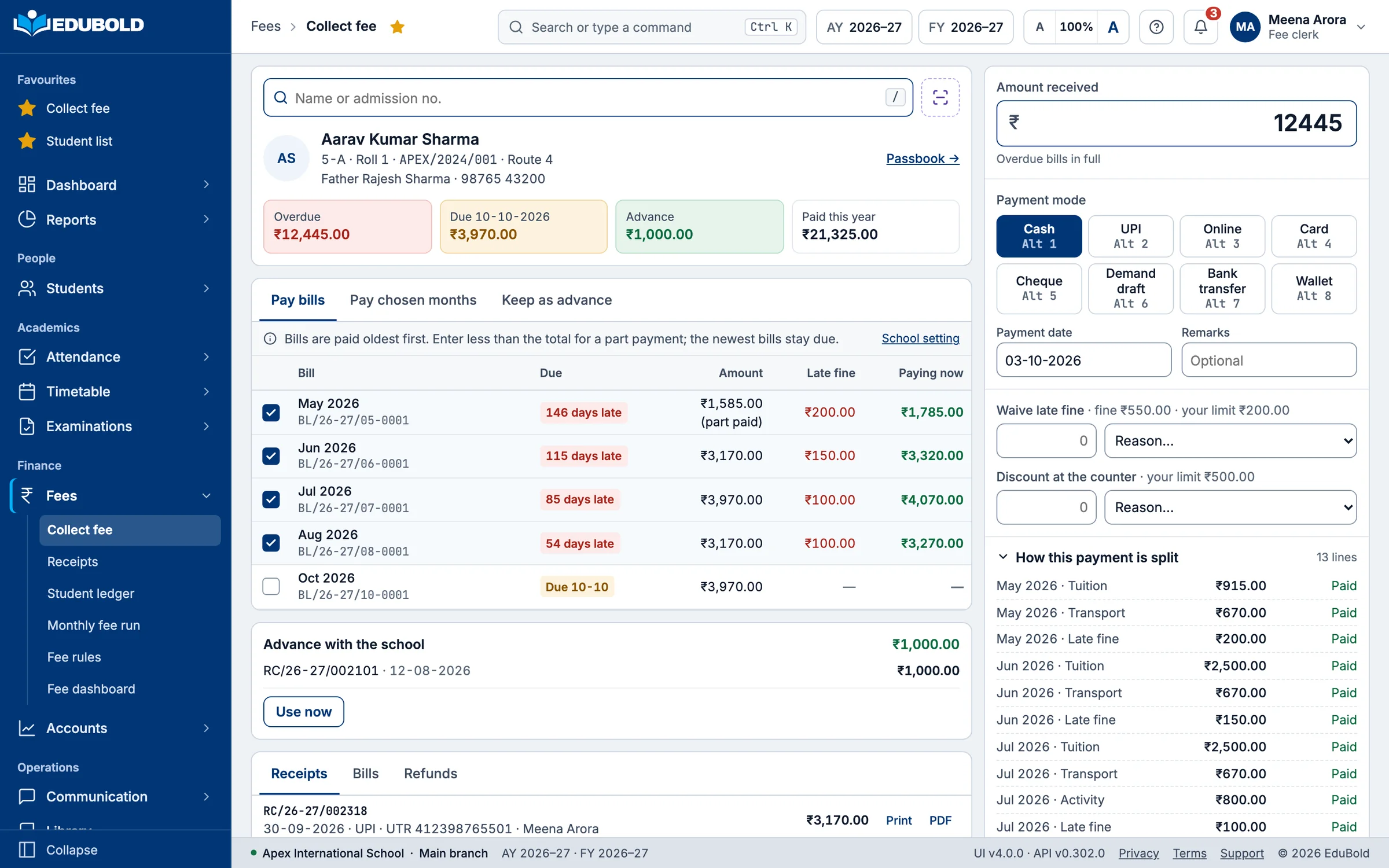
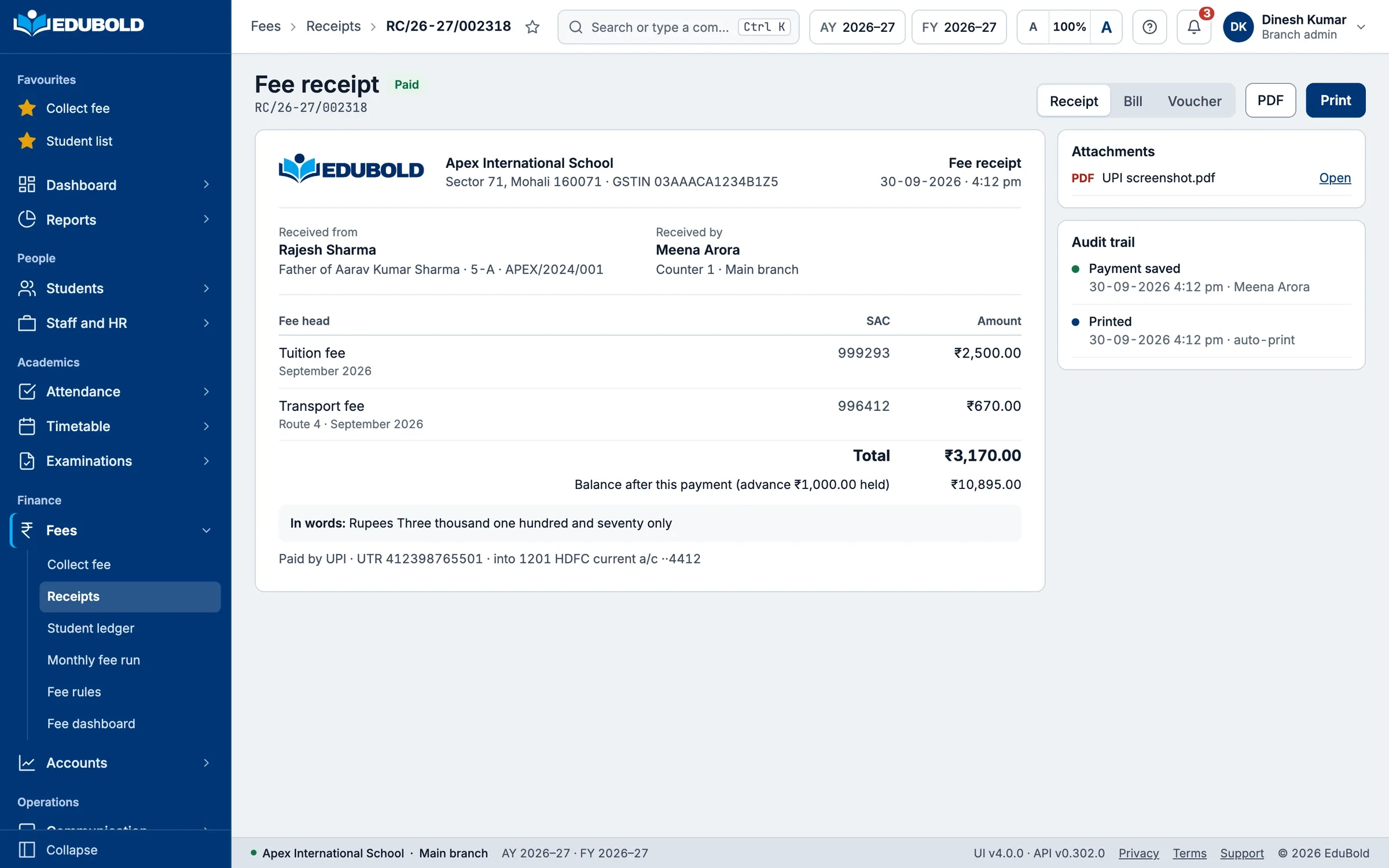
Search the student, take the payment, issue the receipt. Before the screen loads the system checks whether the bills are actually there, so a clerk cannot collect against nothing.
The receipt prints as a PDF. It also becomes a journal entry in the general ledger and on the student’s own account, without anyone posting it.
Overpayment becomes credit, not a refund cheque.
A parent pays extra. It becomes a credit balance on the student, applied to the next bill, and you can list every student currently holding credit.
A cheque bounces and it is a tracked event against both the receipt and the student, not a note in the margin.
Reminders run from a list, and the list remembers who was called.
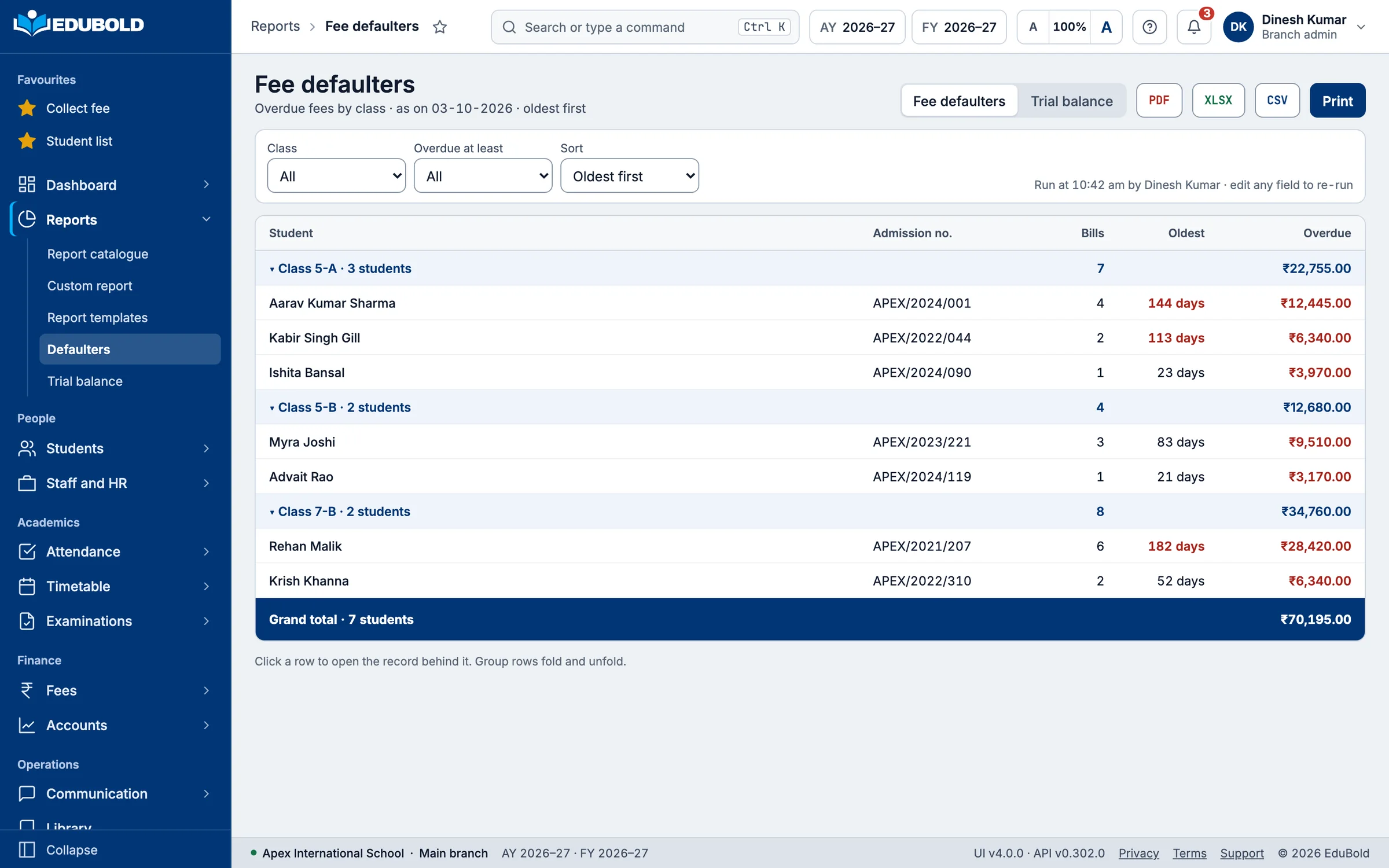
The defaulters report carries the parent’s contact details and the overdue detail already attached. Reminders run from configured rules, and every reminder is logged per bill and per student, counted per rule.
So the same parent is not contacted twice in the same week by two different people running the same reminder.
Concessions go through approval.
Apply, approve or reject, revoke. A concession is a governed decision with a record, not an editable box on a form that anyone with access can change.
Fee revisions mid-session work the same way. So do transfers of credit from one student to another, which need approval on both sides.
Year end does not mean rebuilding.
Rollover runs in three stages. Preview it and see exactly what will happen. Execute it. And if it was wrong, roll it back.
Very little in this category offers the third one.
Collect your fees/The detail that decides it
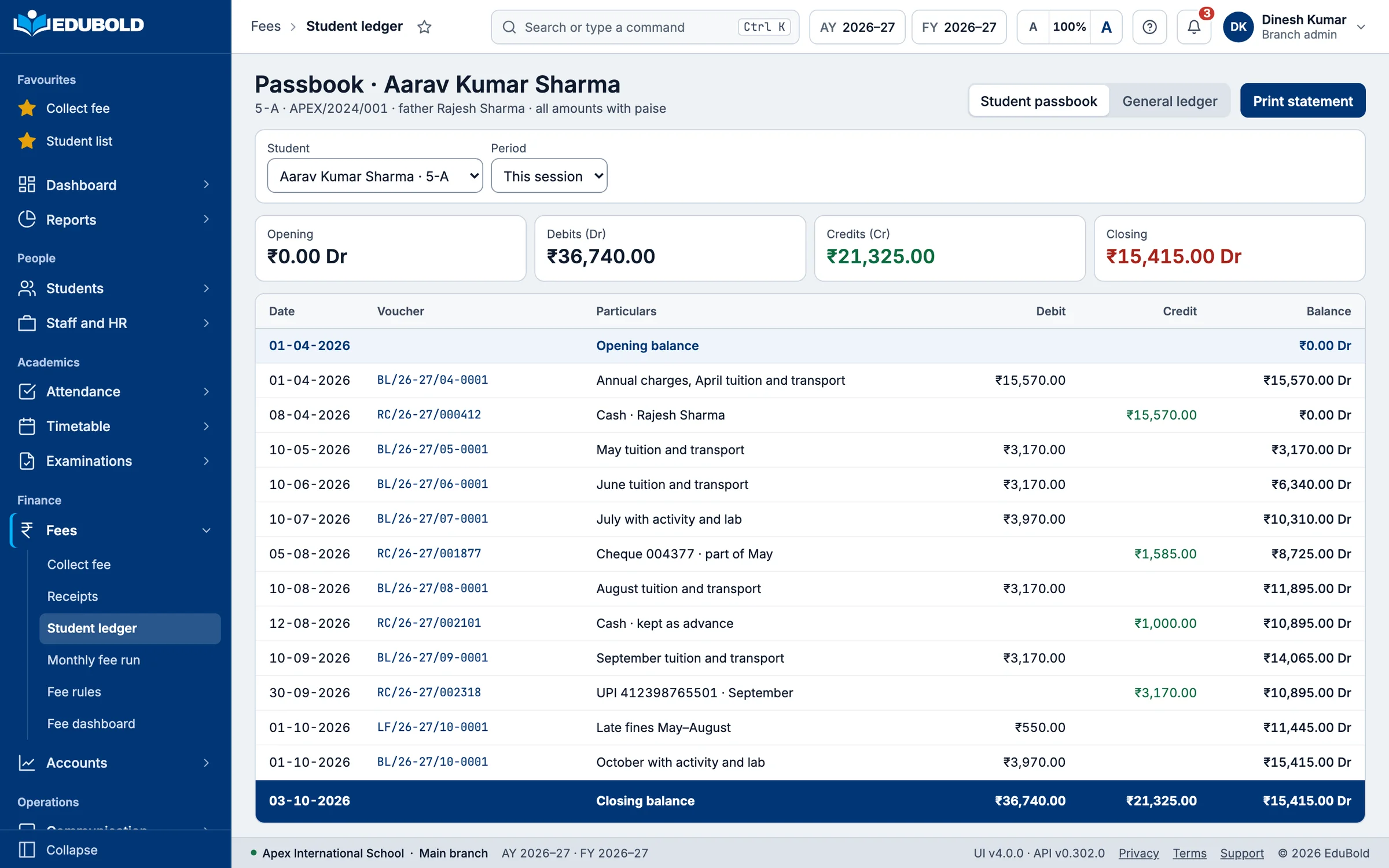
The student ledger.
One child, one running account. Every bill, every payment, every discount, every concession, every refund, every credit, in the order it happened.
When a parent disputes an amount from four months ago, this is the screen that settles it. Not because it proves them wrong, but because it shows the whole history in order.
Most fee systems can tell you a balance. Rather fewer can tell you how it got there.
Collect your fees/Proof
A school where almost no two groups paid the same way.
RTE quota students. Children of staff. Scholarship holders on two different rates. And a registration fee whose eligibility depends on two things at once: the class a student was admitted into, and the class they are in now.
They had evaluated several school management systems first. Every one could hold a fee structure. None could express that.
There is no per-school build here either. There is a rule engine whose conditions read the student’s own record. 35 rules cover the whole admission-class to current-class matrix. Each one adds a fee head that is not in the base plan.
Their principal sent us a sample of their data. We configured about 10 rules and showed him his own students billed correctly, at 95% of what he needed. He paid us nothing for that, and bought EduBold once he had seen it. It runs on 40 rules now.
The same offer stands. Send us a sample of your data and the fee rules you actually apply, and we will show you your own students billed correctly. It costs you nothing, and you decide whether to buy after you have seen it.
Collect your fees/For the management committee
The number the committee actually watches.
Fee billed, collected and outstanding by class. Collection broken down by fee head, so you can see which charges land and which do not. Daily collection split between cash, cheque and online. A receipt register and a refund register, both audit-ready, all exporting to Excel, CSV or PDF.
Every payment posts straight to the ledger as it is taken. So the finance report and the accounts are reading the same figures, and nobody has to make them match.
Collect your fees/Short films
See it in under a minute.
Each film opens on its own page, with the worked example, the questions schools ask and the full transcript.

Next
Bring your hardest question.
Half an hour, on the problems your school actually has. Bring the thing your current system cannot do, and you will watch EduBold run it against your own rules before you decide anything.