
Pay your staff10 / 11
Payroll is only difficult on the last three days of the month.
And it is difficult then because the numbers arrive from somewhere else. Attendance from a register. Leave from a file. Loan deductions from a note. Somebody assembles them, and somebody else checks the assembly.
Pay your staff/The problem today
The numbers arrive from somewhere else, and somebody checks the assembly.
- Attendance and leave are compiled by hand into a payroll sheet.
- PF, ESI and professional tax are calculated in a spreadsheet with last year’s ceilings.
- ESI stops applying above a salary limit, and whether that is caught depends on who is doing the sheet.
- Income tax is estimated, then corrected in February in a hurry.
- Payslips are printed and handed out, so anyone who loses one comes back to the office for another.
- Issuing Form 16 to every member of staff takes days of work, once a year, against a deadline.

Pay your staff/What EduBold changes
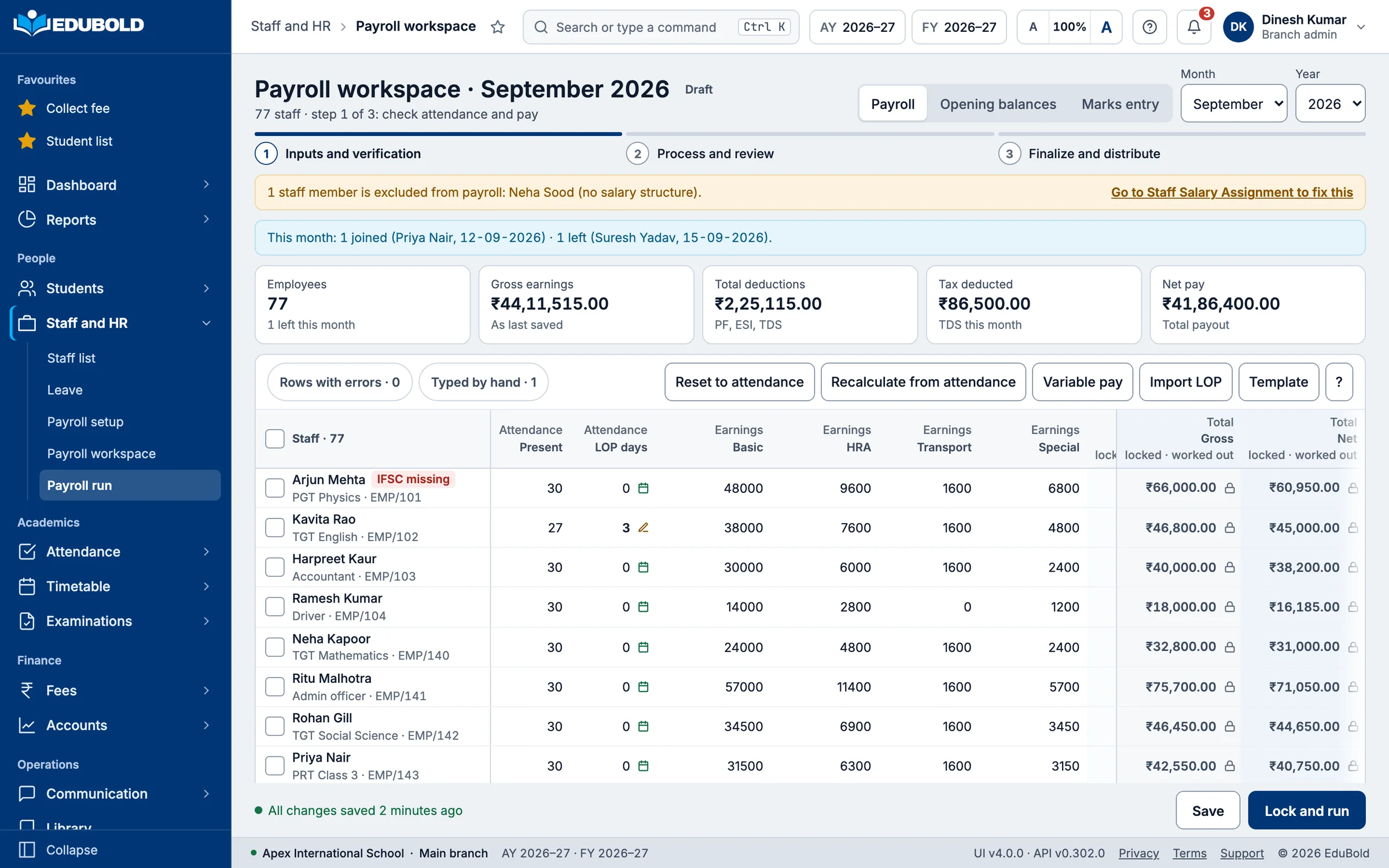
Attendance becomes the payroll input.
Nobody compiles anything.
Loss-of-pay days come from the attendance the school already took, prorated on paid days against working days.
Monthly attendance summaries are generated for all staff, linked to the payroll run, and can be finalised or unfinalised if something needs correcting before the run closes.
The statutory calculation is configured, not compiled.
PF, ESI, professional tax and income tax are calculated from rules you hold, with the base selected per rule: Basic plus DA, Gross, or taxable income.
Eligibility caps apply themselves. ESI simply stops applying when an employee’s gross crosses the threshold. Nobody has to remember. Contribution caps apply themselves too: employer PF is capped at its statutory maximum.
And when the government moves a ceiling, you change a field. The ceilings are data, not constants in the code, so there is no waiting for a release in the month it matters.
Voluntary PF, done the way it actually works.
An employee can choose to contribute on their full Basic plus DA. Their side then goes uncapped and absorbs the employer’s share of the excess. The employer side stays capped at the statutory maximum.
That sentence is either meaningless to you or it is the reason you will take this seriously. It is the detail most payroll products get wrong, and getting it wrong is invisible until an employee checks.
Income tax that knows the difference between the regimes.
Old regime or new, taken from each employee’s own declaration. Regime-appropriate standard deduction. Projected annual income including bonus. HRA exemption on the statutory minimum of three.
Slabs are held per financial year as data. Surcharge bands are regime-aware: 10, 15, 25 and 37 per cent under the old regime, capping at 25 per cent under the new one with no 37 band.
Staff declare their own investments online, with exemption types, and the declaration feeds the monthly TDS projection.
The run has states, and you can watch them.
Initiated, running, calculating, validating, completed. Also failed, cancelled, paused, resumed, partially completed, error and retry.
Validation runs before finalisation, so problems surface before money moves.
Payslips go out by themselves.
Generated for the run, rendered as PDFs, emailed to staff. Staff download their own, and a payslip can be regenerated after a correction.
The bank file comes out to specification.
NEFT in the 80-character fixed-length CTS format with header, transactions and trailer. RTGS in the 240-character format.
Salary files generate to bank specification, ready for NEFT and RTGS, so the upload is one step your accounts person already knows how to do.
Finalising posts to the books.
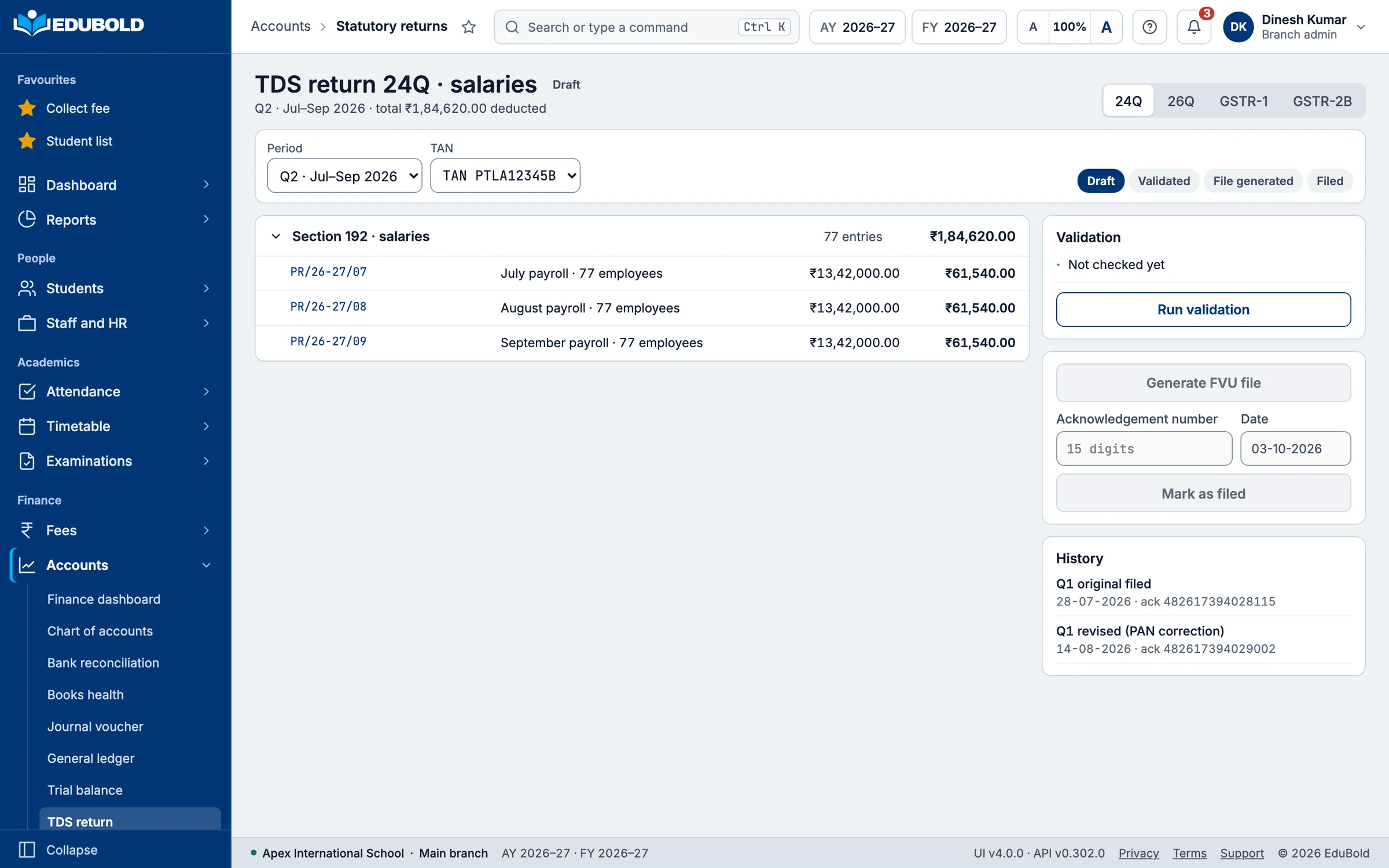
Salary, PF, ESI and TDS journal entries appear in the general ledger. No export, no month-end entry.
Pay your staff/The detail that decides it
The staff record knows what a certificate is worth.
Teaching qualifications and staff documents do not just get uploaded. They get verified, then approved or rejected, as distinct steps with a record of who did it.
Every school has a drawer of certificates that somebody once looked at. When a board inspection asks whether every teacher’s qualification has been checked, the honest answer is usually that they were checked at interview by a person who has since left.
Here the answer is a screen.
Pay your staff/For the management committee
The largest line in the budget, and the one that carries personal exposure.
Staff cost is the largest line in a school budget, and statutory exposure on payroll is the one that carries personal consequences for the management committee.
Three things matter here. The statutory calculation is rule-driven and auditable, rather than living in a spreadsheet on one person’s machine. Form 16 and Form 24Q generate from the same data that ran the payroll. And payroll posts to the ledger when it is finalised, so the salary figure in the accounts and the one in HR cannot drift apart.
Gratuity is recorded with a standard calculation, which is the liability a committee is usually least sighted on.
Pay your staff/Short films
See it in under a minute.
The film opens on its own page, with the worked example, the questions schools ask and the full transcript.

Next
Bring your hardest question.
Half an hour, on the problems your school actually has. Bring the thing your current system cannot do, and you will watch EduBold run it against your own rules before you decide anything.