
For principals and heads
You did not take this job to spend your day on paperwork.
Every problem in a school eventually reaches your desk. Most of them reach it late, and most of them are questions somebody should have been able to answer without you.
This page is about getting those questions answered before they become your problem.
The problem
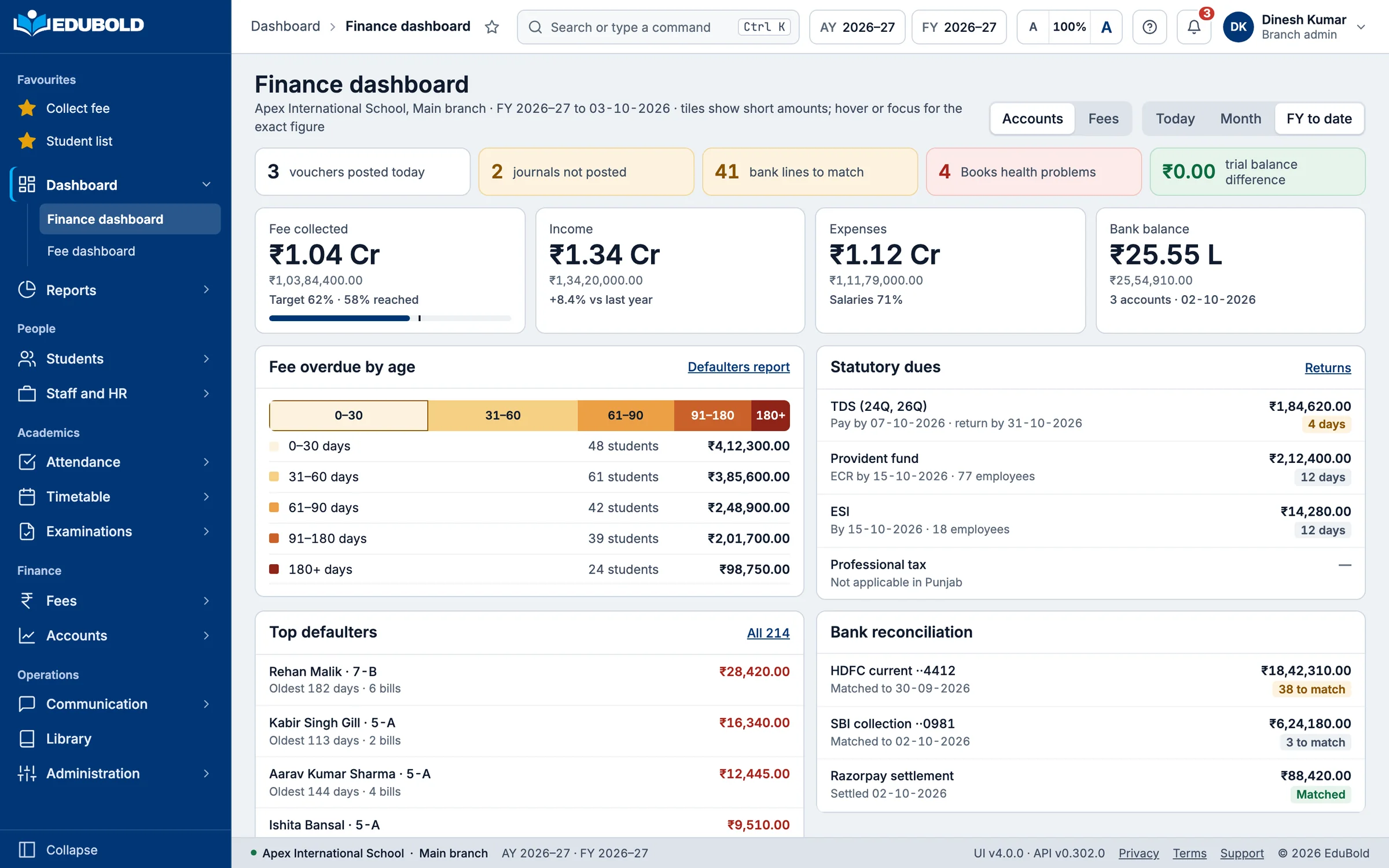
The first screen, before the first knock on the door.
Not a report someone prepares for you. The screen you open with your tea.
The overdue fees sit on the same screen, sorted by how long they have been due, with the defaulters list one click away. Not everything happening in the school. The money that will become a problem this week if nobody looks.
On the screen
- Fees collected, against the target
- Income and expenses for the year
- Money in the bank, account by account
- Fees overdue, by how long
- Statutory dues, and when each is due
The problem
The five things that take it.
“The timetable takes three weeks.”
It takes an afternoon. You set the constraints, the rooms, the periods and each teacher’s preferences, and the system places the week. It reports what it could not place and why, lists every clash, and suggests a fix for each one.
When a teacher is away, substitution is a workflow, not a rebuild. And you can see every teacher’s workload before term starts, rather than discovering in October that one person has thirty-four periods.
“Fees are overdue and nobody can say who owes what.”
The rules decide what each child owes. You set the conditions once, and the system applies the discount, the waiver or the extra component per student, every month, without a spreadsheet.
When collection starts slipping, you open the defaulters list. It has the parent’s contact details and the overdue detail already attached, and it logs who was contacted and when, so the same parent is not called twice by two different people.
“I cannot answer a parent immediately.”
One screen holds one child. Attendance, fee summary, invoices, payments, exam results, academic history, their subjects and who teaches each one, library books, messages, health, siblings, awards, discipline.
The parent is still on the phone when you have the answer.
“My office types the same thing three times.”
They do not, here. A parent applies on your website. When they accept the offer, the student record and their login already exist. The fee structure attaches from the rules. The receipt the clerk writes is already a journal entry in the books.
Nobody retypes anything, which means nobody has to reconcile anything.
“I find out too late.”
Bills due today and due soon are calculated by the system, not remembered by a person. Admission applications sitting unverified are visible. A biometric device that has stopped reporting shows up as a failed sync the same day, not at month end when the payroll is wrong.
The detail that decides it
The class health summary.
A teacher taking 6-B on a trip needs one sheet: which children have allergies, how severe, who carries medication, blood groups, and who to call.
It prints from the student records that are already there. There is also a per-child emergency card for the school bag, and a list of every student in the school with a condition staff need to know about.
No school buys software for this. Every principal recognises why it matters.
Getting there
A single school can be running on it in a week.
How long the move takes is decided by your data, not by us. A single school starting at the top of a session can be live in a week. A trust moving mid-session, carrying opening balances and a year of fee history, is closer to ten. What decides it is the state of your master data and how much of the year you are carrying across.
It gives the office an exact list to work from. Fee follow-up stops being a question of who remembers. EduBold names who to call, what they owe, and who spoke to them last.

Next
Bring the thing your current system cannot do.
Half an hour, on the problems your school actually has. You will see it run, and we will say so in the call.